
Small Diameters
Pins, shafts and sleeves reviewed around stock diameter and unsupported length.
Small, slender and feature-dense parts
Swiss-type machining supports small bar-fed components by guiding stock close to the cutting area. It is commonly evaluated for slender geometry and parts combining turned features with drilling, threading, grooves, flats or cross-machined details.
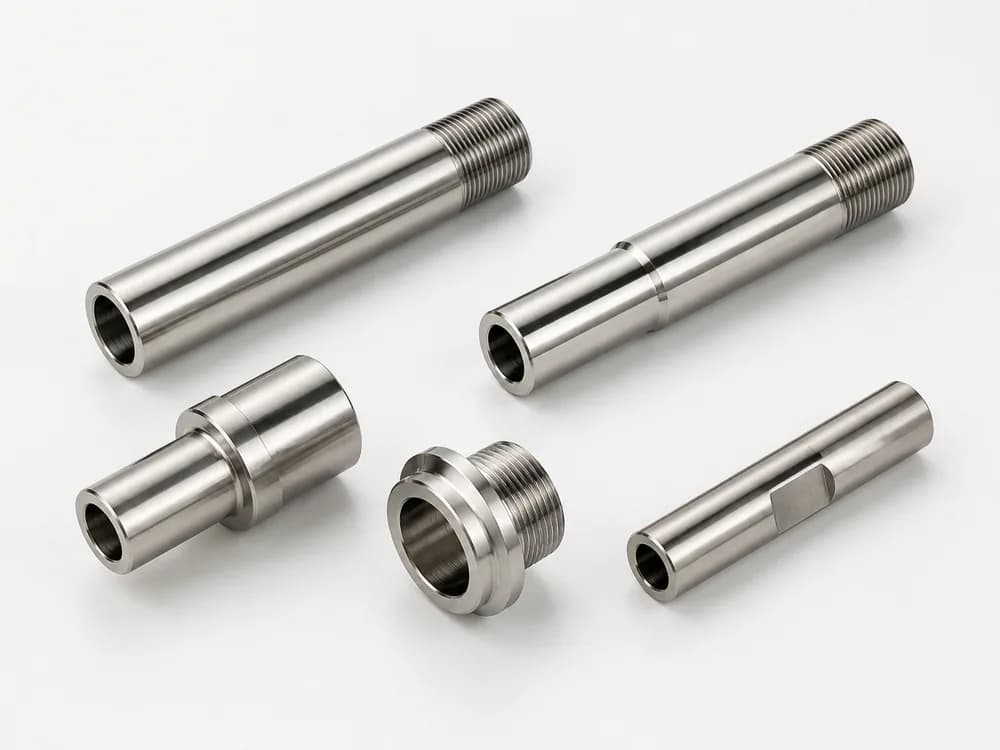
Process capabilities
These capability groups are a starting point. Final equipment, setup and inspection planning remain subject to drawing review.
Pins, shafts and sleeves reviewed around stock diameter and unsupported length.
Grooves, tapers, shoulders and threads planned from the controlled drawing.
Radial holes, flats and slots evaluated with available live-tool access.
Bar-fed process concepts assessed against quantity and inspection demand.
Common part types
Part names are only a guide. Geometry, critical characteristics and quantity determine the actual manufacturing route.
Material planning
Commonly reviewed for small corrosion-resistant and medical-equipment parts.
Suitable grades support lightweight feature-dense components.
Often considered for small fittings, connectors and threaded parts.
Specific grade and dimensional stability require drawing-based review.
RFQ checklist
A focused quotation starts with the current revision and identifies which features matter most to function and acceptance.
Start Your Project ReviewFrequently asked questions
Project-specific answers require the controlled drawing, material and quantity.
Small pins, shafts, sleeves, fittings and other feature-dense bar components are common candidates, subject to geometry and quantity review.
Swiss-type machines support bar stock close to the cutting zone and are often selected for small or slender parts. Conventional turning may be more suitable for larger or simpler components.
Many concepts combine turning with drilling, flats, slots or cross-holes, depending on tool access and equipment configuration.
Material, bar diameter, part length, feature count, tool access, cycle complexity, quantity, deburring and inspection requirements all matter.
Upload the current drawing, material, quantity and critical requirements for a focused manufacturing review.