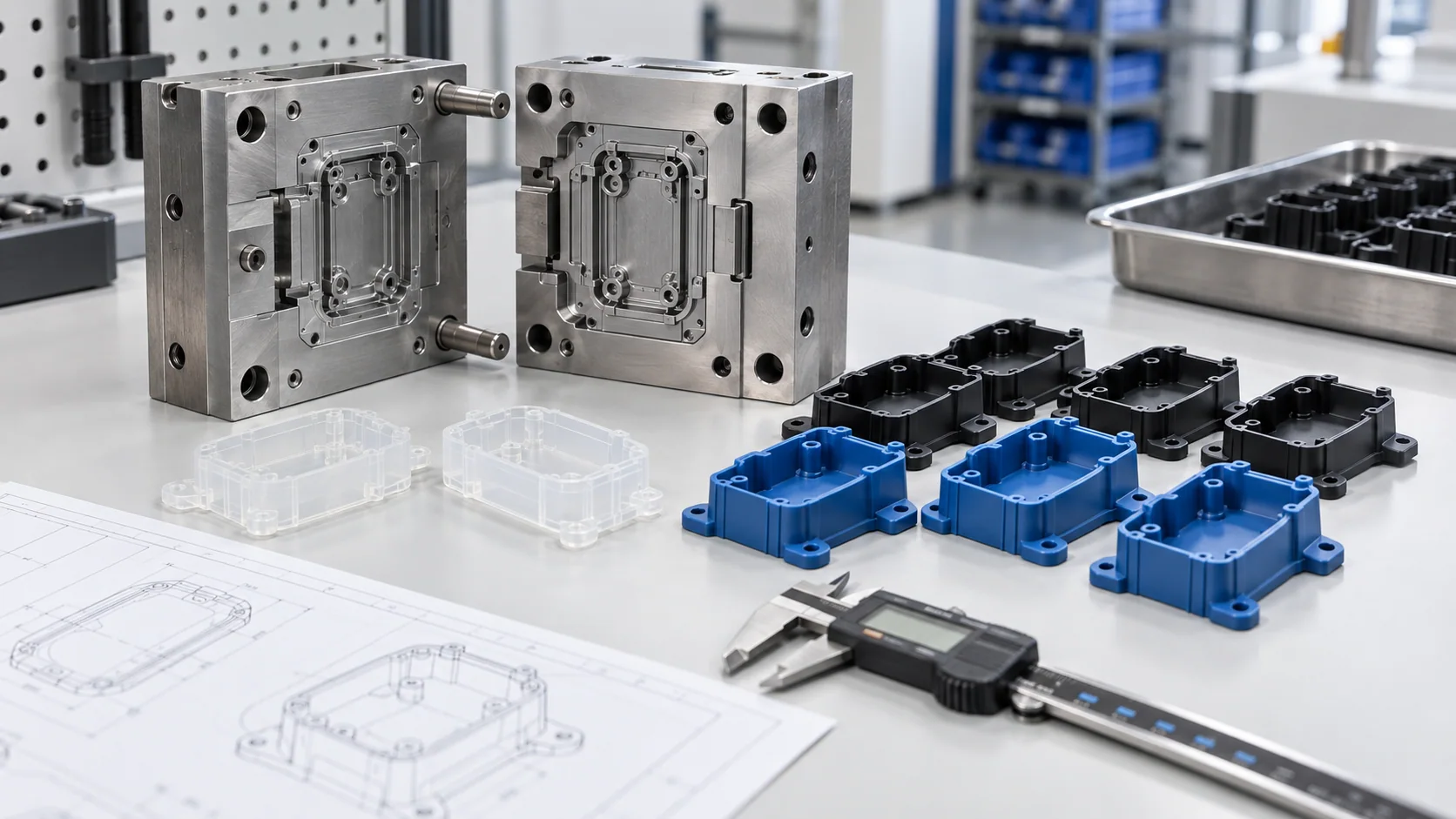
Low-volume injection molding is most useful when production-like material behavior, repeatability and unit economics justify tooling—but the decision depends on total program demand, not a universal quantity threshold.
Key takeaways
Move toward tooling when molded material behavior, repeatability, finish or recurring demand matters more than avoiding every upfront cost.
Compare total program cost and schedule—including tooling, samples, changes, inspection and repeat releases—instead of unit price alone.
A quote-ready RFQ defines resin, annual and release quantities, drawing revision, cosmetic standards, critical dimensions and sample approval.
01
What low-volume injection molding actually means
Low-volume injection molding uses production-style molding equipment and a dedicated tool to make a limited or bridge-production quantity of plastic parts. The label does not describe one fixed quantity range. Part size, resin, cavity count, tool construction, change risk and future demand determine whether the route is commercially sensible.
The goal may be to obtain production-intent material behavior, improve repeatability, support pilot builds, supply an early market launch or bridge the gap before a higher-capacity tool is ready. Buyers should define the program objective first because it changes tool life, automation, inspection and ownership decisions.
- Engineering validation with production-intent resin
- Pilot or market-entry production
- Bridge supply before a long-life production tool
- Service parts or controlled recurring demand
02
Screen the project against prototype alternatives
CNC machining and additive manufacturing can be faster for early geometry checks because they avoid dedicated molding tools. They may remain the right choice while the design is changing frequently or when only a handful of parts are needed. However, a machined or printed polymer part may not reproduce molded fiber orientation, knit lines, gate effects, shrinkage, texture or identical wall behavior.
Low-volume molding becomes more attractive when the team needs repeated parts in the specified molding resin, when appearance and assembly behavior must be evaluated under a production-like process, or when cumulative demand makes repeated prototype production inefficient. The crossover must be calculated for the actual design and forecast.
- Use CNC or additive prototypes for fast geometry learning and frequent revisions
- Consider molding for production-intent resin and process behavior
- Include all expected releases, not only the first purchase quantity
- Recheck the business case if the design or forecast changes
03
Evaluate tooling economics with total program cost
A tooling quotation is only one part of the program. Sample rounds, design changes, mold maintenance, secondary operations, inspection fixtures, packaging and shipping can materially affect total cost. A low tool price can become expensive if the mold cannot meet the required resin, finish, dimensional stability or expected number of cycles.
Ask suppliers to make assumptions visible. The quotation should identify cavity count, intended tool material, expected maintenance approach, included sample rounds, ownership, storage and what happens when a customer revision changes the cavity. Compare suppliers on the same controlled requirements rather than on headline tooling price.
- Tool construction and cavity count
- Included DFM review and sample rounds
- Expected maintenance, storage and ownership terms
- Piece price at realistic quantity breaks
- Secondary operations, inspection and packaging
- Engineering-change cost and schedule impact
04
Complete DFM before releasing the mold
Injection molding DFM should review wall thickness, draft, ribs, bosses, undercuts, shutoffs, gate location, parting lines, ejector locations and likely shrinkage or warpage. These decisions affect both part performance and what can be changed after metal is cut.
Mark cosmetic surfaces, no-gate areas, critical sealing features and assembly interfaces on the drawing. If texture or color matters, define an objective reference and viewing conditions. A signed DFM package and frozen drawing revision reduce the chance that the sample is evaluated against requirements the tool was never designed to meet.
- Wall transitions and nominal wall strategy
- Draft and texture requirements
- Ribs, bosses and screw features
- Undercuts, slides and lifters
- Gate, ejector and parting-line restrictions
- Shrinkage, warpage and critical datum plan
05
Specify resin and appearance precisely
A generic resin family such as ABS, PC or nylon is not a complete material specification. Grade, reinforcement, flame rating, color, recycled-content restrictions, UV or chemical exposure and required declarations can change processing and tooling decisions. If an equivalent material is acceptable, define the properties and approval route rather than allowing an uncontrolled substitution.
Appearance standards should describe the surfaces that matter and the defects that are unacceptable. Color matching, gloss, texture, weld-line location, gate witness, ejector marks and allowable flash should be reviewed using agreed samples or standards. Cosmetic expectations added after tooling can force avoidable rework.
- Exact manufacturer and grade or controlled approval criteria
- Color reference and masterbatch requirement
- Reinforcement, additives and regulatory declarations
- Texture, gloss and appearance-critical surfaces
- Allowable gate witness, flash, sink, weld lines and ejector marks
06
Build sample approval and production control into the plan
First samples should verify more than whether the cavity fills. The team should confirm drawing dimensions, material and color, appearance, assembly performance and any application-specific test. Record the approved process conditions and identify which changes require new customer approval.
For repeat releases, define lot identification, inspection frequency and required records. Dimensional stability may depend on conditioning time, moisture, temperature and measurement fixture, particularly for reinforced or moisture-sensitive polymers. The drawing and inspection plan should explain how critical dimensions are evaluated.
- First-article dimensional report where required
- Material, color and appearance approval
- Assembly or functional test
- Approved sample retention
- Lot traceability and inspection frequency
- Packaging that prevents deformation or cosmetic damage
07
Prepare a quote-ready low-volume molding RFQ
Provide the current 3D model and controlled 2D drawing, then add the information that geometry cannot communicate: exact resin, quote quantity, release plan, annual forecast, target timing, cosmetic zones, testing, documentation and packaging. State whether the tool is for validation, bridge production or recurring supply.
MIM Machining reviews drawing-led plastic injection molding projects from DFM and tooling through samples and repeat production. Upload the file package so tooling scope, part price, sample approval and production controls can be reviewed together.
- 3D CAD model, 2D drawing and revision
- Exact resin, color, texture and finish
- Initial quantity, quantity breaks and annual forecast
- Critical dimensions and functional interfaces
- Cosmetic acceptance standard
- Sample, inspection and documentation requirements
- Tool ownership, storage, maintenance and delivery expectations

Julie Cai
Project contact connecting international customers with MIM Machining's manufacturing and engineering review team.
Contact Julie