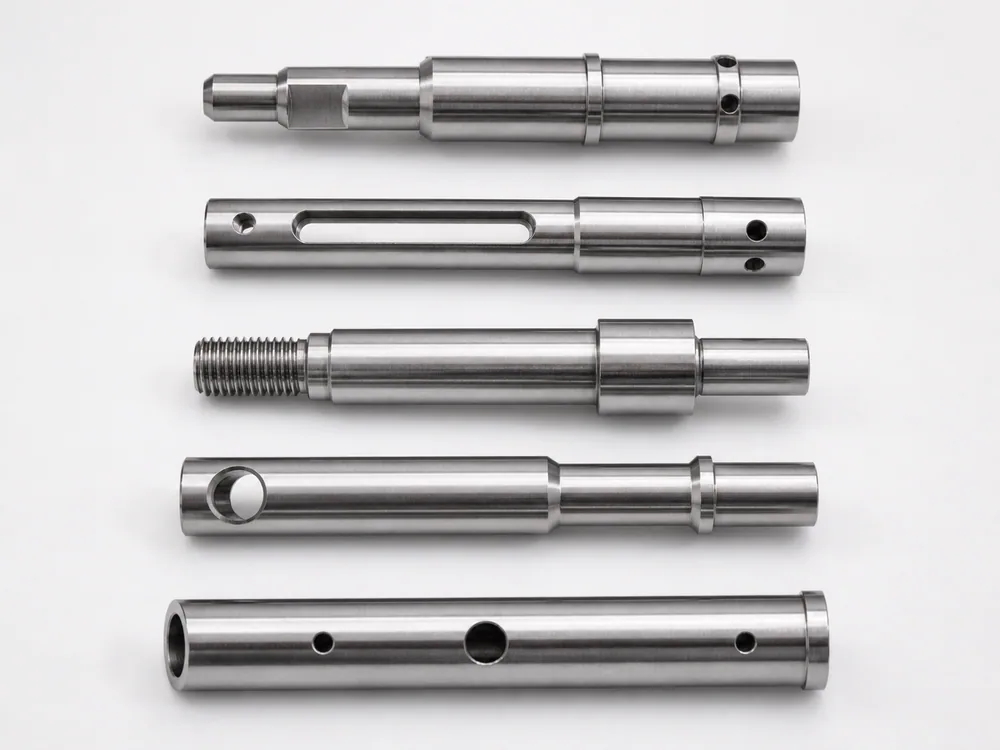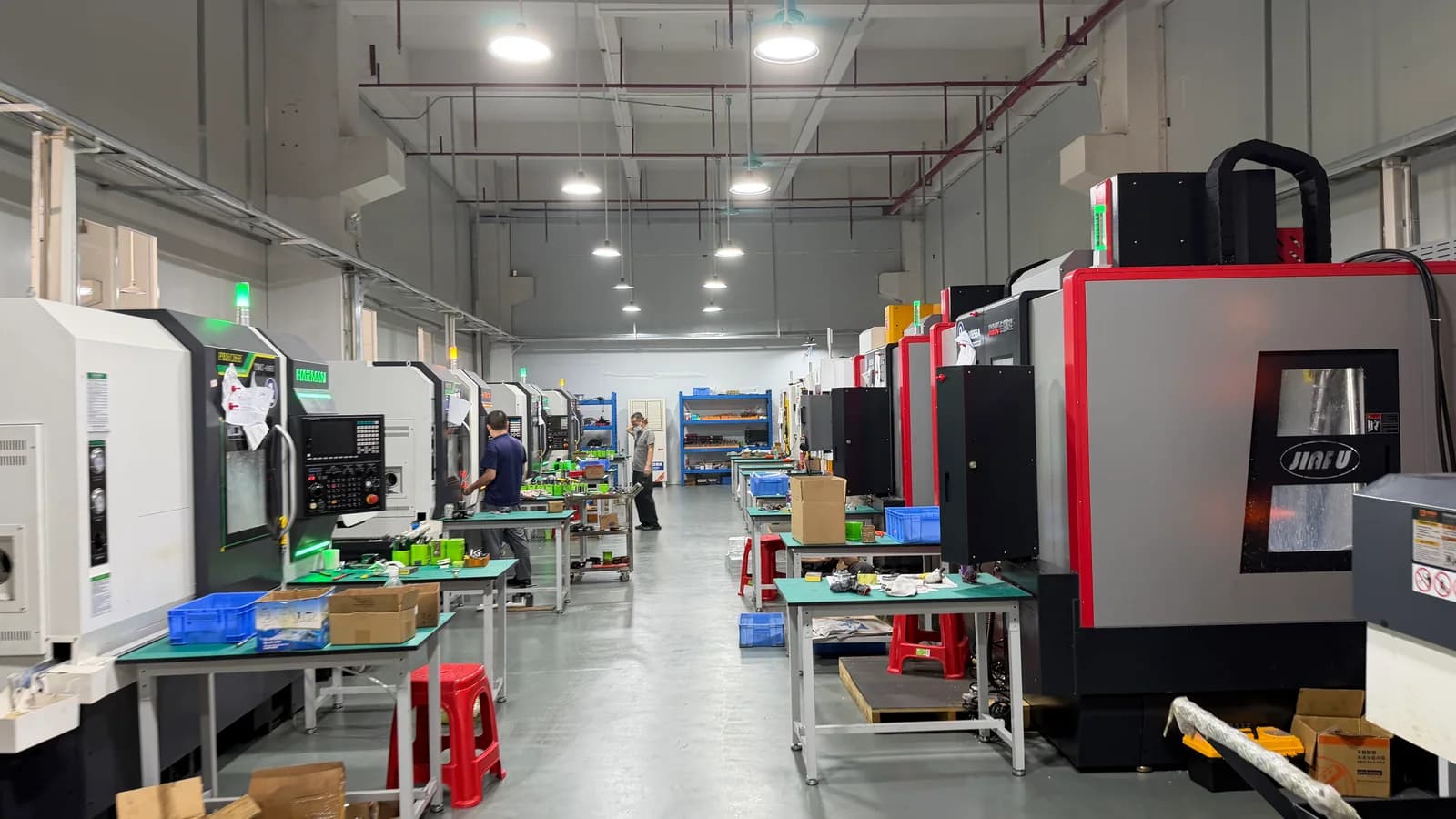
Swiss machining is usually the stronger candidate for small, slender parts that need support close to the cut and several turning or live-tool operations in one cycle. Conventional CNC turning is often the simpler, more economical choice for short, rigid rotational parts. The correct route depends on the complete drawing, bar stock, feature access, quantity and inspection plan—not on diameter alone.
Key takeaways
Swiss-type turning supports bar stock close to the cutting zone, which can reduce deflection risk on slender small-diameter parts.
A conventional CNC lathe can be the better-value route for short, rigid parts that do not benefit from a guide bushing or extensive back-working.
The quotation should define bar material, quantities, critical feature relationships, surface finish, inspection and documentation rather than asking for a process by name only.
01
Quick answer: choose from the geometry and production plan
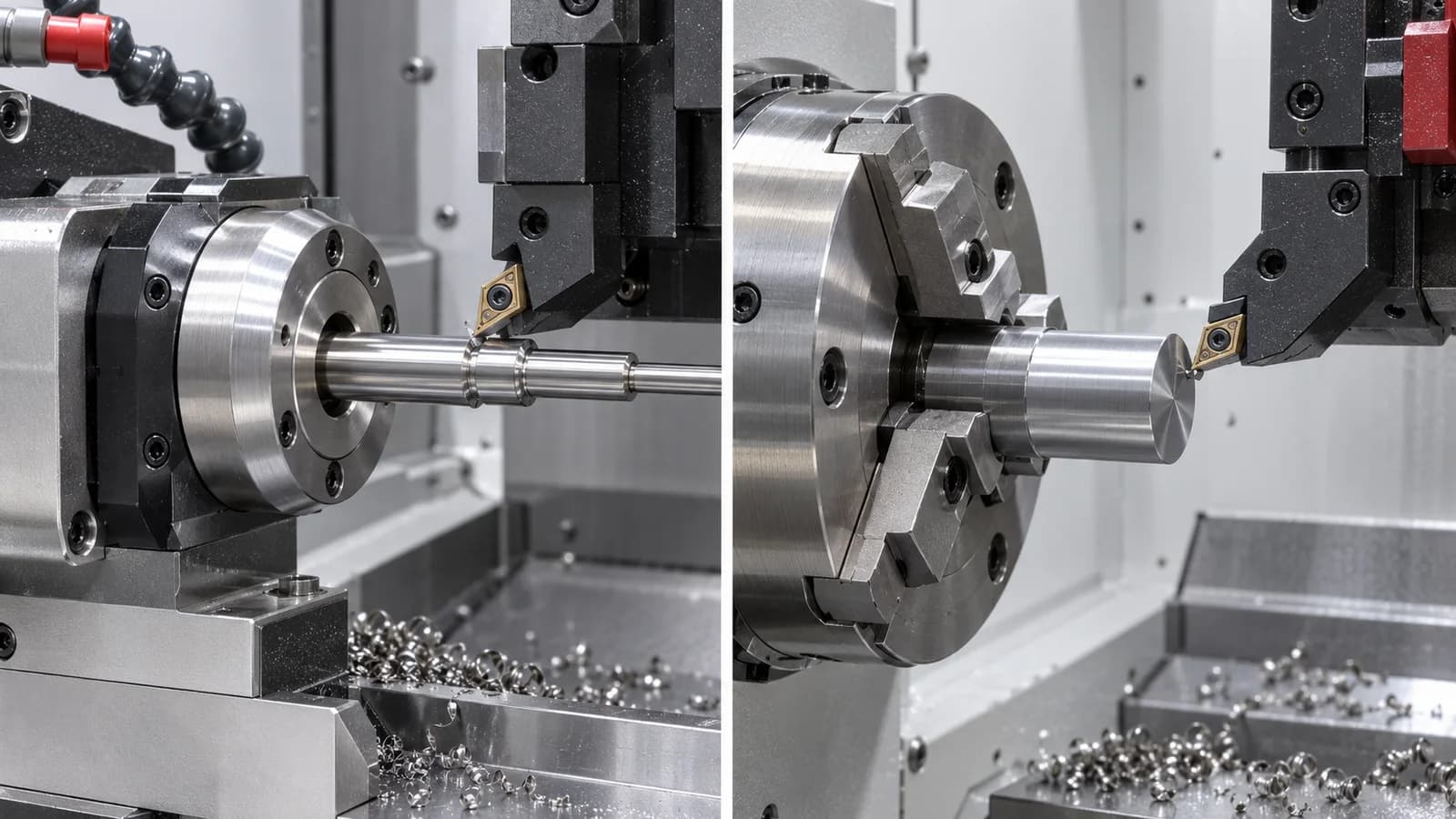
The process image above illustrates the central support difference: the Swiss-type setup on the left brings the guide bushing close to the cutting point, while the conventional fixed-head setup on the right holds a short, rigid workpiece in a chuck. It is an original process illustration, not a photograph of MIMCNC production equipment.
Choose Swiss machining when a small part is long or flexible relative to its diameter, when concentric turned features must be combined with cross holes, flats, slots or back-working, or when repeat production can justify a more involved setup. A sliding headstock feeds bar stock through a guide bushing, so the cutting tool works close to the point of support. That arrangement is the defining advantage for controlling workpiece deflection.
Choose conventional CNC turning when the component is short and rigid, the main features are concentric, access is straightforward and the expected quantity does not justify a complex Swiss setup. Modern fixed-head lathes may also use live tooling and a sub-spindle, so the decision is not simply ‘complex part equals Swiss machine.’ Compare the actual operation sequence, setup risk and total delivered cost.
| Decision factor | Swiss-type machining | Conventional CNC turning | What the buyer should confirm |
|---|---|---|---|
| Part shape | Strong fit for small, slender bar-fed parts | Strong fit for short, rigid rotational parts | Finished diameter, overall length and unsupported sections |
| Workpiece support | Guide bushing supports stock near the cut | Chuck or collet supports the work from the spindle | Where cutting force acts relative to support |
| Secondary features | Live tools and back-working can combine many features in one cycle | Live tooling may be available; a second setup can still be practical | Cross holes, flats, slots, off-axis holes and rear features |
| Quantity | Setup is easier to justify for repeat demand | Often economical for prototypes and simpler batches | Prototype quantity, first release and annual demand |
| Raw material | Bar straightness and diameter consistency are especially important | More flexibility for blanks and short bar or slug work | Stock form, material condition and certification |
| Cost driver | Programming, tooling, guide-bushing setup and cycle optimization | Setup count, chucking, live-tool time and secondary operations | Total route, not machine hourly rate alone |
02
How Swiss machining supports a slender workpiece
On a Swiss-type sliding-headstock lathe, the bar moves axially through a guide bushing while tools cut close to the bushing face. The short distance between support and cutting zone limits the length of stock exposed to cutting force. This is useful when a conventional chucking arrangement would leave a small shaft, pin or sleeve vulnerable to bending, chatter or taper.
The guide bushing is not an automatic guarantee of accuracy. Its fit must match the bar, and the stock must meet the straightness, roundness and diameter consistency needed by the selected setup. Poor bar preparation can create friction, marking or dimensional variation. Some Swiss machines can run without the guide bushing for shorter parts, reducing remnant length and avoiding the need for guide-bushing-quality stock. Machine configuration therefore belongs in the process review, not in a generic capability promise.
03
Where conventional CNC turning remains the better choice
A fixed-head lathe can be direct and productive for short, rigid parts, larger diameters and cut blanks. If critical surfaces are completed from one chucking or a simple sub-spindle transfer, a guide-bushing setup may add no value.
Do not confuse Swiss machining with turn-milling
Swiss describes a sliding-headstock architecture; turn-milling describes combining turning with rotating-tool operations. A Swiss machine may perform cross drilling, milling, slotting and back-working, while a fixed-head turn-mill center can perform many of the same feature types. The process choice depends on workpiece support, capacity, tooling arrangement and the sequence needed to protect critical relationships.
04
Feature complexity: count relationships, not just operations
A small precision part may include an outside diameter, bore, multiple threads, wrench flats, radial holes, an axial slot and a rear-face feature. Producing those details across several machines creates handling and datum-transfer decisions. A Swiss-type machine with live tooling and a sub-spindle may complete more of the part in one cycle, reducing work-in-process and the number of times the part is relocated.
Single-cycle production is not automatically superior: special holders or separate grinding, honing, EDM or finishing may still be necessary. Identify the relationships that are function-critical. Concentricity between a bore and outside diameter, cross-hole position and thread runout may matter more than the number of operations.
05
Material, bar stock and surface-finish considerations
Swiss machining can process many engineering metals and selected plastics, but grade and stock condition influence the route. Stainless steel and titanium need chip and tool-life planning; plastics need heat and burr control. Because the guide bushing contacts the bar, diameter consistency, straightness and surface condition affect feeding and can affect the part. Identify any surface that must remain as supplied.
Passivation, anodizing, plating, black oxide and electropolishing can change appearance, edge condition or functional dimensions. Include finishing in the tolerance and masking plan rather than adding it after machining is quoted.
06
Tolerance and inspection: make the drawing measurable
No responsible process selection starts with a universal Swiss-machining tolerance. Achievable variation depends on diameter, length, material, feature type, tool reach, thermal behavior, bar quality, quantity, measuring method and the relationship between datums. A tolerance that is routine on a rigid outside diameter may be difficult on a thin wall, a deep micro-bore or a flexible long shaft.
Define functional datums and apply tight tolerances only where assembly or performance needs them. Thread callouts should state the standard, class, hand and any gauge or inspection requirement. For small parts, the measurement method must suit the feature: optical systems can be useful for profiles and small distances; gauges may control threads or bores; contact measurement may be needed for other characteristics. Sampling and reporting requirements should be agreed before quotation because 100% inspection, capability studies or detailed reports change the scope.
07
How quantity and total cost change the decision
Swiss setups require programming, multiple tools, guide-bushing preparation and prove-out. That investment becomes attractive when one cycle consolidates operations and repeat demand spreads setup cost. For a few prototypes, a conventional lathe plus secondary milling may be more economical. At higher quantities, handling and repeated setups may reverse that result.
Ask for quantity breaks and disclose expected annual demand. Compare material and remnant, setup, cycle, secondary operations, finishing, inspection, documentation, yield risk and packaging—not the machine rate alone.
08
What to send for a Swiss-machining quotation
Send both the current STEP model and controlled 2D drawing. The model communicates geometry; the drawing controls tolerances, threads, finishes, datums and requirements that may not exist in the solid model. Include the initial quantity and realistic repeat demand so the supplier can compare a Swiss route with conventional turning or turn-milling.
- Finished part diameter, overall length and any length-to-diameter concerns
- Exact material grade, stock condition and certification or traceability needs
- Critical datums, GD&T, runout, concentricity, thread and surface-finish callouts
- Cross holes, flats, slots, rear features and any areas with restricted tool access
- Prototype quantity, production quantity, expected annual usage and revision stage
- Deburring, cleaning, heat treatment, coating, passivation, marking and packaging
- Inspection method, sampling, reports, gauges and first-article expectations
09
Technical references
Machine-builder and tooling guidance was used for process fundamentals. The released drawing and selected equipment remain controlling.
10
Send your small precision part for process review
MIMCNC supports CNC turning, turn-milling and Swiss-type machining for custom drawing-based parts. Send the latest 2D drawing and STEP file with material, quantities, critical features, finish and inspection requirements. The team can review whether Swiss machining, conventional CNC turning or a combined route is the practical starting point before quotation.
Use the inquiry page or contact Julie Cai at juliecai@mimcnc.com and +86 136 7015 0900. Scope and delivery expectations are confirmed for each project.
Frequently asked questions
Questions engineers and buyers ask before quotation.
What is the main difference between Swiss machining and CNC turning?+
A Swiss-type lathe moves bar stock through a guide bushing and cuts close to that support. A conventional fixed-head lathe normally holds the work in a chuck or collet while tools move along the exposed part. The support arrangement is the key distinction.
Is Swiss machining only for high-volume orders?+
No, but its programming, tooling and setup effort often become more economical as repeat quantity increases. A low-volume complex or slender part may still justify Swiss machining when it avoids difficult secondary setups.
Does every small-diameter part need Swiss machining?+
No. Short, rigid parts with straightforward concentric features may be faster and less expensive on a conventional CNC lathe. Diameter alone does not determine the process.
Can Swiss machines mill flats, slots and cross holes?+
Many Swiss-type machines use live tooling and sub-spindles for milling, drilling, slotting and back-working. The available axes, tools and access depend on the specific machine configuration and part geometry.
Why does bar-stock quality matter in Swiss machining?+
The guide bushing supports and contacts the bar near the cut. Diameter variation, straightness and surface condition can affect fit, feeding, friction and dimensional consistency, so the required stock condition should be reviewed before quoting.
What files produce the most useful quote?+
Provide a STEP model and controlled 2D drawing plus the exact material, prototype and repeat quantities, critical tolerances, threads, finishes, inspection reports and documentation requirements.
Plan the next step
Continue from guide to project review.

Julie Cai
Project contact connecting international customers with MIM Machining's manufacturing and engineering review team.
Contact Julie